Homelessness Response Director calls for expanded services, community support
What do you think?
JOPLIN, Mo. — Addressing homelessness in the Joplin area will require more than enforcing camping ordinances or providing temporary shelter.
It will take a coordinated community effort, expanded services and significant public and private investment, according to Layne Bourgeous, regional Director of Homelessness Response.
In an interview with NewsTalk KZRG, Bourgeous said Joplin needs a more comprehensive system to help people experiencing homelessness, including a full-service day center and a 24-hour emergency shelter for those with nowhere else to go.
He said the community has made progress, but existing resources fall short of what's needed to address the problem.
"We need to continue to build on that," Bourgeous said. "We want it to be comprehensive, we want it to be robust. We want it to be able to meet the needs of anybody and everybody who is experiencing homelessness, to come in and have the opportunity to get out of homelessness."
Homelessness has many causes
Bourgeous cautioned against the assumption that everyone experiencing homelessness struggles with mental illness or substance abuse.
He said homelessness affects people in different circumstances, including those who lose their housing because of financial hardship, illness or other unexpected events.
While mental health and substance use disorders can contribute to chronic homelessness, he said, those challenges do not explain the entire problem.
"We do need to be very real and acknowledge that is an issue and that is a concern," Bourgeous said. "But with that subpopulation and not apply that to the full spectrum of homelessness."
Older adults are an increasingly vulnerable group, he said.
Bourgeous identified people age 60 and older as the fastest-growing demographic experiencing homelessness. He described how the death of a spouse can leave someone living on Social Security or a pension unable to cover housing, utilities, food and medication on a single income.
Limited affordable housing options can leave those individuals with few alternatives.
"There really are a lot of contributing factors to it, and we have to keep that in mind as we're creating a system to address homelessness," he said.
Day center would offer a starting point
One of the priorities identified in the community's plan to address homelessness is a comprehensive day service center where people can access multiple services in one location.
The plan envisions a facility offering services such as showers, laundry, medical care and assistance connecting people with resources to help them move out of homelessness.
Joplin has taken an initial step through the Salvation Army's Opportunity Center, where multiple service providers offer assistance on a rotating basis every Tuesday and Wednesday.
Bourgeous praised the Salvation Army for making its facilities available, noting that the center already offers showers, laundry facilities and morning and midday meals.
However, he said, the current arrangement is not enough to meet the community's needs.
Expanding those services will require additional providers, staffing, infrastructure and money to cover operating expenses.
Bourgeous said the challenge is finding the resources to build on existing programs and develop a more comprehensive operation.
Service locations help explain homeless people downtown
The concentration of people experiencing homelessness around Spiva Park has drawn attention, but Bourgeous said the location is not surprising.
Several organizations providing assistance are clustered nearby, including Watered Gardens, Souls Harbor, the Salvation Army and Economic Security Corporation, which operates the region's coordinated entry system for connecting people with housing resources.
People naturally gravitate toward places where they believe their needs can be met, he said.
Bourgeous believes a dedicated day center could reduce the number of people congregating in the park during the day.
However, he cautioned against expecting one facility to eliminate homelessness or guarantee that people will no longer gather in public spaces.
"I do believe that we would see less," he said.
He also noted that appearances alone do not establish whether someone is homeless.
Enforcement is only part of the response
Joplin's enforcement of its camping ordinance has raised questions about what happens to people who are displaced from parks and other public property.
Bourgeous said law enforcement has an important role in enforcing city ordinances, but enforcement should not be the end of the process.
When someone experiencing homelessness is taken into custody, he said, the goal should include connecting that individual with services that could help address the underlying circumstances.
The city is working to improve connections between its jail and the coordinated entry system, he said.
Bourgeous also described the enforcement process outlined by Joplin Police Chief Pearson to the City Council. Under that process, an initial violation brings a verbal warning, a subsequent violation results in a written citation, and a third violation can lead to arrest.
He said balancing accountability with compassion is important.
Joplin also needs a 24-hour, low-barrier emergency shelter, Bourgeous said. Such a facility would provide an option for people who have nowhere else to go, particularly those who face barriers to accessing other shelters.
"Let's give them a place to be," he said.
Bourgeous acknowledged that establishing such a shelter would be a significant undertaking requiring community resources.
Homeless camps remain a refuge for some
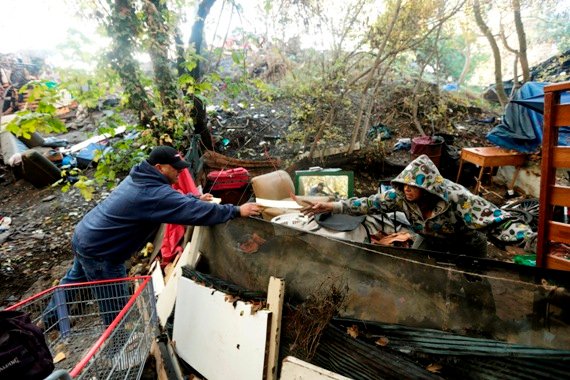
Although Bourgeous could not say whether the number of homeless encampments around Joplin has increased or decreased, he said he's confident the camps still exist.
Based on information shared by service providers, he said some people may be staying farther from central areas rather than gathering in more visible locations.
That can make it harder for outreach workers to connect them with assistance.
Community partnerships are essential
Bourgeous works with the Regional Commission on Homelessness, a nonprofit organization intended to bring community leaders together to help coordinate the response to homelessness.
The commission works alongside the homeless coalition, which includes service providers, to identify barriers that prevent people from receiving assistance.
The commission's role is to bring those challenges to the attention of city officials, county leaders and others who have the authority or resources to help resolve them.
Bourgeous said successful efforts in other communities have relied on both strong public support and private-sector investment.
"On the flip side, they have strong private sector support," he said. "It has to be public-private partnerships that are going to be successful in addressing these solutions or these struggles."
He said Joplin needs that same kind of cooperation to fully implement its community plan.
Bourgeous said he would like to see the community secure all the financial and personnel resources needed to put the plan into action.
He cautioned that completely eliminating homelessness is not a realistic expectation. A more attainable goal, he said, is to ensure that the number of people moving out of homelessness equals or exceeds the number entering it.
"If we had the resources to be able to ensure that as many people coming into homelessness equaled or less than those coming out, that's the best we can hope for," Bourgeous said.
For Joplin, he said, making that progress will depend on teamwork and recognizing that homelessness is not a problem any single agency or organization can solve alone.
